Currently a 21% chance the U.S. government confirms aliens are real before the end of 2026, up from 10% two months ago.
The U.S. government's flying saucer archive runs from 1947 into the 1970s and spans thousands of pages of witness reports, military intelligence memos, photographs, and Air Force analyses. Most of it is administrative: form-letter replies to citizens, routing covers, and liaison memos shuffling reports between agencies.
But buried inside are sworn statements from military pilots, photographs of alleged spacecraft, an Air Force analytical memo concluding that “something is really flying around,” and records of the strangest walk-ins, hoaxes, and crashes ever filed in the federal archives. These twelve documents are the ones worth reading.
1. The Socorro Cop
On April 24, 1964, a Socorro, New Mexico patrolman named Lonnie Zamora was chasing a speeder when he heard a roar to the southwest and saw a bluish-orange flame descending behind a hill. Thinking the local dynamite shack had blown, he dropped the chase.
What he found over the rise wasn't an explosion. It was a shiny aluminum-white egg-shaped craft sitting in an arroyo on two legs angled outward. Two figures in white coveralls stood beside it. One looked up, and according to Zamora “seemed startled , seemed to quickly jump.”
Zamora radioed dispatch: “possible 10-44, I'll be 10-6 out of the car.” As he stepped out, he heard two loud thumps. Then the roar started, “nothing like a jet,” he said, and he knew jets. Blue and orange flame underneath. He ran. Bumped his leg on the rear fender. His glasses fell off, he left them. He ducked behind a hill.
The roar stopped. The object slid away in dead silence, ten to fifteen feet off the ground, cleared the dynamite shack by three feet, and vanished over the mountain.
The investigating federal agent, D. Arthur Byrnes Jr., had known Zamora for five years. He wrote that the man was “sober, industrious, and conscientious, not given to fantasy.”Byrnes documented four landing-leg indentations, three burned grass patches, and three jar-lid-like circular marks in the dirt.
Project Blue Book, which closed thousands of UFO cases as balloons or hoaxes, kept Socorro on its short list of permanent “unidentified.” Dr. J. Allen Hynek, Blue Book's chief skeptic, said for the rest of his life that Socorro was the case that changed his mind.
A small-town cop. A federal agent on scene within hours. Real-time radio dispatch. Measurable physical evidence. No camera. No book deal. Sixty-two years later, it's still one of the cleanest UFO records in the world.
2. The Hottel Memo
One of the most-viewed declassified UFO documents in existence is one page long. It was sent on March 22, 1950 by Washington Special Agent in Charge Guy Hottel to J. Edgar Hoover. Subject: “Flying Saucers.”
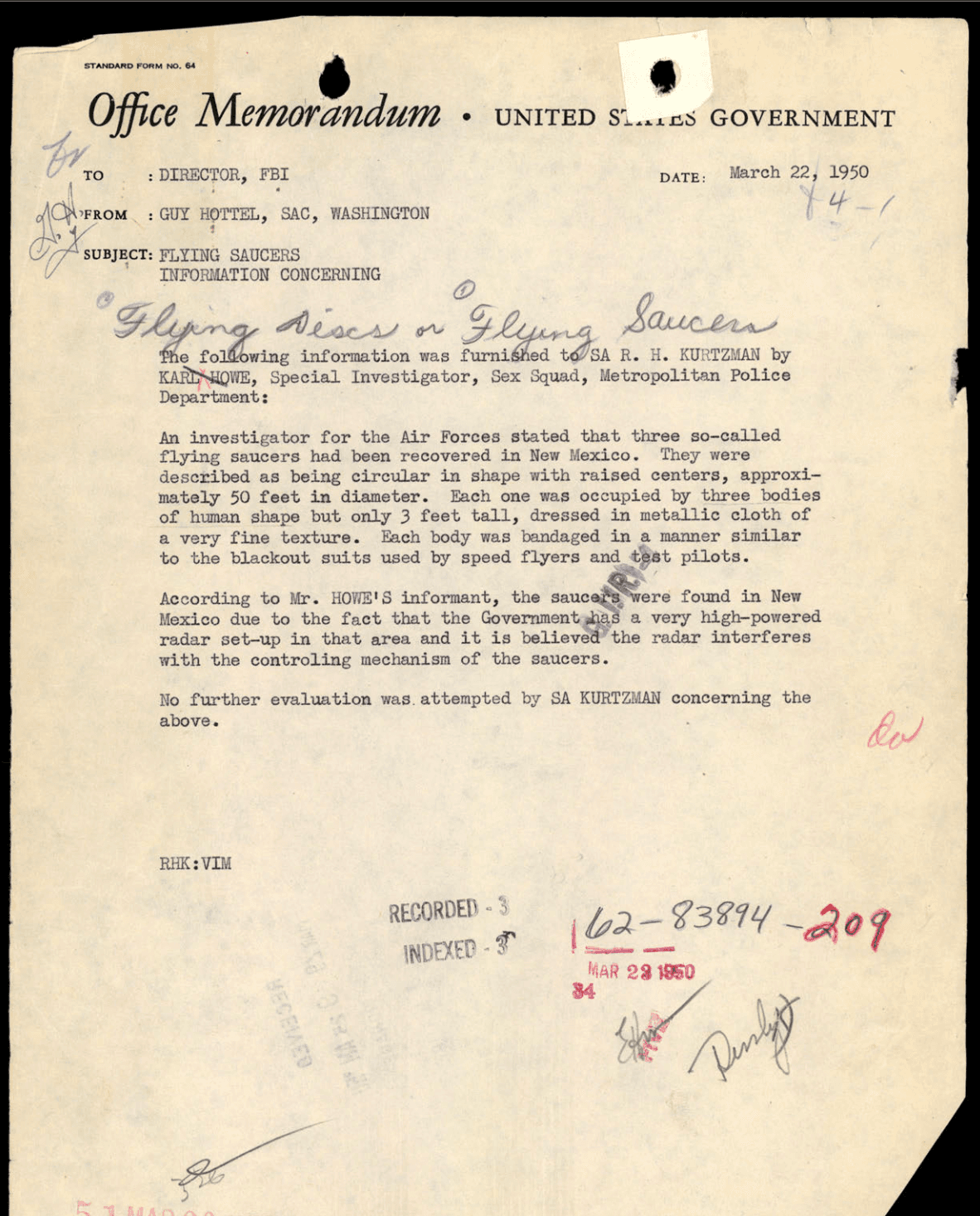
Hottel reports that an Air Force investigator told a third party that three flying saucers had been recovered in New Mexico. The saucers were circular, with raised centers, approximately 50 feet in diameter. Each one, the investigator said, was occupied by three bodies of human shape, only three feet tall, dressed in metallic cloth of very fine texture, wearing the kind of bandage flight suits used by speed flyers.
The reason given for the recovery: high-powered radar in the area was “interfering with the controlling mechanism of the saucers.”
Hottel adds: “No further evaluation was attempted by SA [redacted] concerning the above.”
The memo wasn't endorsed. It wasn't investigated. It was simply filed.
What makes the memo important isn't whether it's true. It's that the Roswell crash-recovery rumor existed inside federal channels in 1950, three years after the Roswell incident, and decades before Roswell became a household word in the 1980s. The 50-foot saucers, the 3-foot bodies, the metallic suits, the radar-interference explanation, every component of the modern Roswell story is already there.
3. How the Bureau Quit the UFO Business in 47 Days
The federal government's investigative involvement with UFOs has a precise start and end date.
July 30, 1947, Bureau Bulletin No. 42. Hoover formally agrees to assist Army Air Forces Intelligence in investigating reports of “flying discs.”
September 3, 1947, Lt. Gen. Stratemeyer's Air Defense Command sends a letter (drafted by Col. R.H. Smith) to its commanding generals describing the Bureau's role. The letter explains that investigators had been enlisted “to relieve the numbered Air Forces of the task of tracking down all the many instances which turned out to be ash can covers, toilet seats and whatnot.”
September 19, San Francisco Special Agent in Charge Harry M. Kimball gets a copy. He writes Hoover an angry letter calling the wording “scurrilous” and “insulting.”
September 25, Asst. Director D.M. Ladd writes Hoover, recommending the Bureau “protest vigorously” and pull out.
September 27, Hoover writes Maj. Gen. George C. McDonald, Asst. Chief of Air Staff: “I cannot permit the personnel and time of this organization to be dissipated in this manner.” Effective immediately, all field divisions are ordered to discontinue investigation of flying discs.
October 1, Bureau Bulletin No. 57 makes it official: “Effective immediately, the Bureau has discontinued its investigative activities... All future reports connected with flying discs should be referred to the Air Forces.”
They didn't walk away because UFOs were debunked. They walked away because they felt insulted by a single sentence in a single Air Force letter.
4. The RAF Mosquito Chase
Buried in the 1947 archive, under a SECRET cypher header from the Joint Communications Office, is a short message from the British Air Ministry to the Pentagon.
It is dated August 8, 1947, but it describes an incident that occurred January 16, 1947, five months before Kenneth Arnold's Mt. Rainier sighting that gave the world the term “flying saucer.”
At 22:30 hours on January 16, an RAF Mosquito on night flying practice was vectored onto an unidentified aircraft at 22,000 feet. A long chase followed, beginning over the North Sea about 50 miles off the Dutch coast, ending at 23:00 over Norfolk, England. During that chase, the Mosquito's airborne intercept radar made two brief contacts with the unidentified aircraft. Both contacts “faded quickly.”
The exact wording of the Air Ministry's report:“The unidentified aircraft appeared to take efficient controlled evasive action.”
The cypher message ends with one more sentence: “No explanation of this incident has been forthcoming nor has it been repeated.”
There was no Soviet jet in 1947 that could outmaneuver an RAF Mosquito at 22,000 feet over the North Sea. There was no American one either.
5. The B-25 That Didn't Land
In June 1947, two Air Force Counter-Intelligence Corps officers , Capt. William Davidson and Lt. Frank M. Brown, were assigned to investigate the early flying disc wave for the 4th Air Force at Hamilton Field, California.
In July, Brown personally interviewed Kenneth Arnold in Boise, Idaho. Brown wrote in his report: “It is the personal opinion of the interviewer that Mr. Arnold actually saw what he stated that he saw.”
Days later, Davidson and Brown went to Tacoma, Washington to investigate the Maury Island case, Harold Dahl and Fred Crisman's claim that six donut-shaped discs had passed over Puget Sound and dropped slag onto Dahl's boat. Crisman gave the officers fragments allegedly from the discs.
On August 1, 1947, Davidson and Brown boarded a B-25 at McChord Field carrying the fragments back to Hamilton Field. The B-25 crashed near Kelso, Washington. Both officers were killed.
In the days that followed, anonymous calls came in to a Tacoma Times reporter named Paul Lantz and to a UP wireman named Ted Morrello. One caller said: “We want this to get back to New Jersey.”
Investigators followed up. On August 7, 1947, both Dahl and Crisman signed sworn statements admitting the entire Maury Island story was a hoax, promoted by Amazing Storiesmagazine editor Ray Palmer, who had hired Arnold to investigate it. The fragments turned out to be ordinary slag.
But the B-25 crash was real. Two officers died. And to this day, the question of why Davidson and Brown were flying back with that material — and what was actually in the cargo — has never been fully answered.
6. “Something Is Really Flying Around”
Within the 1947 archive is a document the Air Force never expected the public to read.
It is an analytical memo from AFBIR-CO, the Air Force's Brigadier-Intelligence Requirements office, dated July 30, 1947, just five weeks after Kenneth Arnold's sighting.
The memo's author had assembled eighteen of the most credible flying disc reports the Air Force had received and broken them down by date, hour, location, observer, occupation, altitude, direction, speed, color, size, shape, sound, trail, weather, and manner of disappearance. The witnesses included military pilots, Civil Air Patrol instructors, NRL scientists, a railroad crew, a B-25 major, and a Newfoundland Constabulary officer.
After studying the reports, the author wrote three conclusions:
(a) “This ‘flying saucer’ situation is not all imaginary or seeing too much in some natural phenomenon. Something is really flying around.”
(b) “Lack of topside inquiries... give more than ordinary weight to the possibility that this is a domestic project, about which the President, etc., know.”
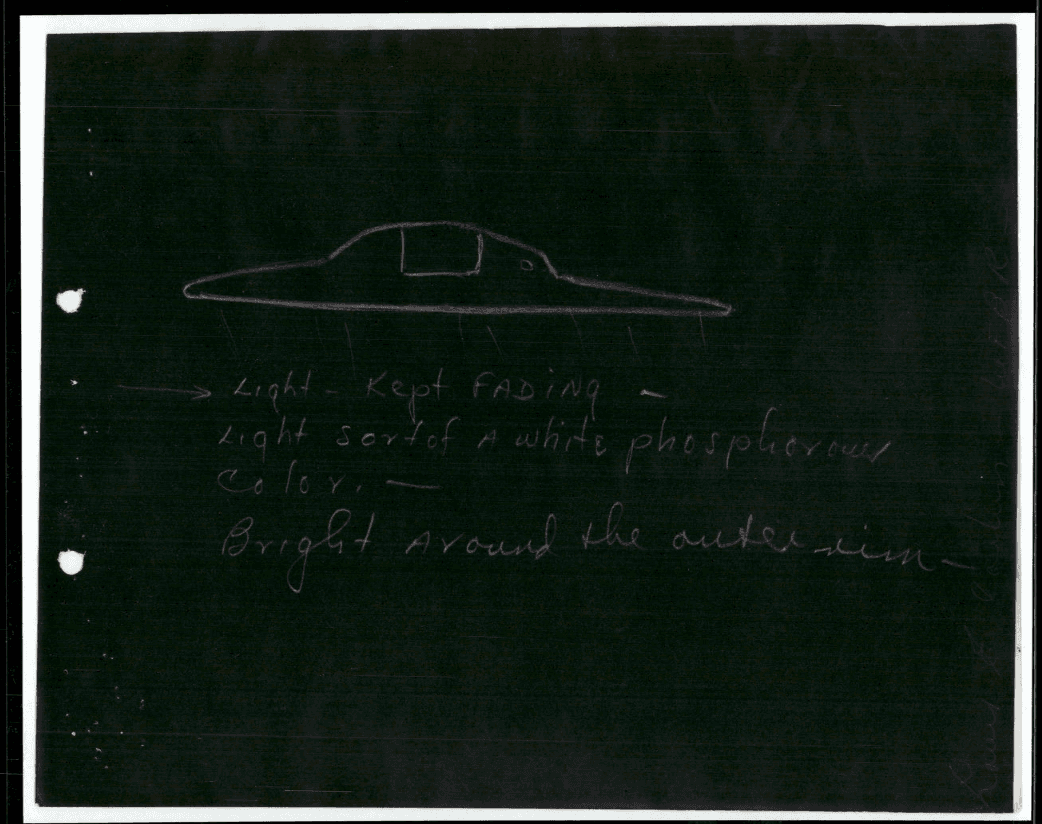
(c) Physical characteristics: metallic skin, blue-brown rocket-like trail (suggesting throttleable liquid fuel), circular or elliptical with a flat bottom and slightly domed top, sized like a C-54 or a Constellation, two rear tabs, formations of three to nine, speeds above 300 knots, lateral oscillation in flight.
This is a 1947 Air Force intelligence officer, working in writing, concluding that something physical and unexplained was operating in U.S. airspace, and that it might be a U.S. domestic black project the President had been briefed on. The memo sat buried for almost 80 years.
7. The Oak Ridge Radar Incident
In the fall of 1950, the United States Air Force's radar station near Knoxville, Tennessee began tracking objects over the Oak Ridge atomic facilities, the X-10 graphite reactor and Y-12 uranium enrichment plants that had built the bomb that ended World War II.
Eleven unidentified objects. At an altitude of 5,000 feet. Speeds ranging from 0 to 47 mph, meaning some were hovering. For four straight days.
F-82 fighter aircraft were scrambled. They found nothing in the air where the radar was painting targets.
The witnesses on the ground were not crackpots. They included Lt. Col. Hood, Commander Hribar of the Navy, and personnel from the Atomic Energy Commission. Multiple witnesses saw a disc-like reflection from a single car.
Federal investigators were briefed because Oak Ridge was on the most sensitive list of nuclear facilities in the country. Espionage was the obvious concern. The AEC issued a special “Report on Unidentified Aerial Objects” form at Los Alamos. Project Twinkle was funded, a network of observation posts at Vaughn and Holloman, New Mexico, to systematically photograph and track the objects. Over 200 sightings were logged. No definitive cause was found.
The most striking line in the Knoxville report, written about a related incident at Oak Ridge, is this:“It nevertheless warrants some consideration from a procedural standpoint.”
Translation: if this had been a real Soviet attack on the country's nuclear facilities, the confused jurisdiction between the Air Force, AEC, Army CIC, OSI, Navy, and federal investigators would have failed.
8. The Former Luftwaffe Pilot's Saucer Photos
In April 1967, a man named Paul L. Peyerl walked into the federal office in Miami. He was 43 years old. Born 1924 in Austria. He told the agents he had served as a test pilot in the Luftwaffe.
In late 1944, he said, he had been assigned to a top-secret project in the Black Forest in southern Germany. The project's lead designer was an Austrian engineer named Kuehr.
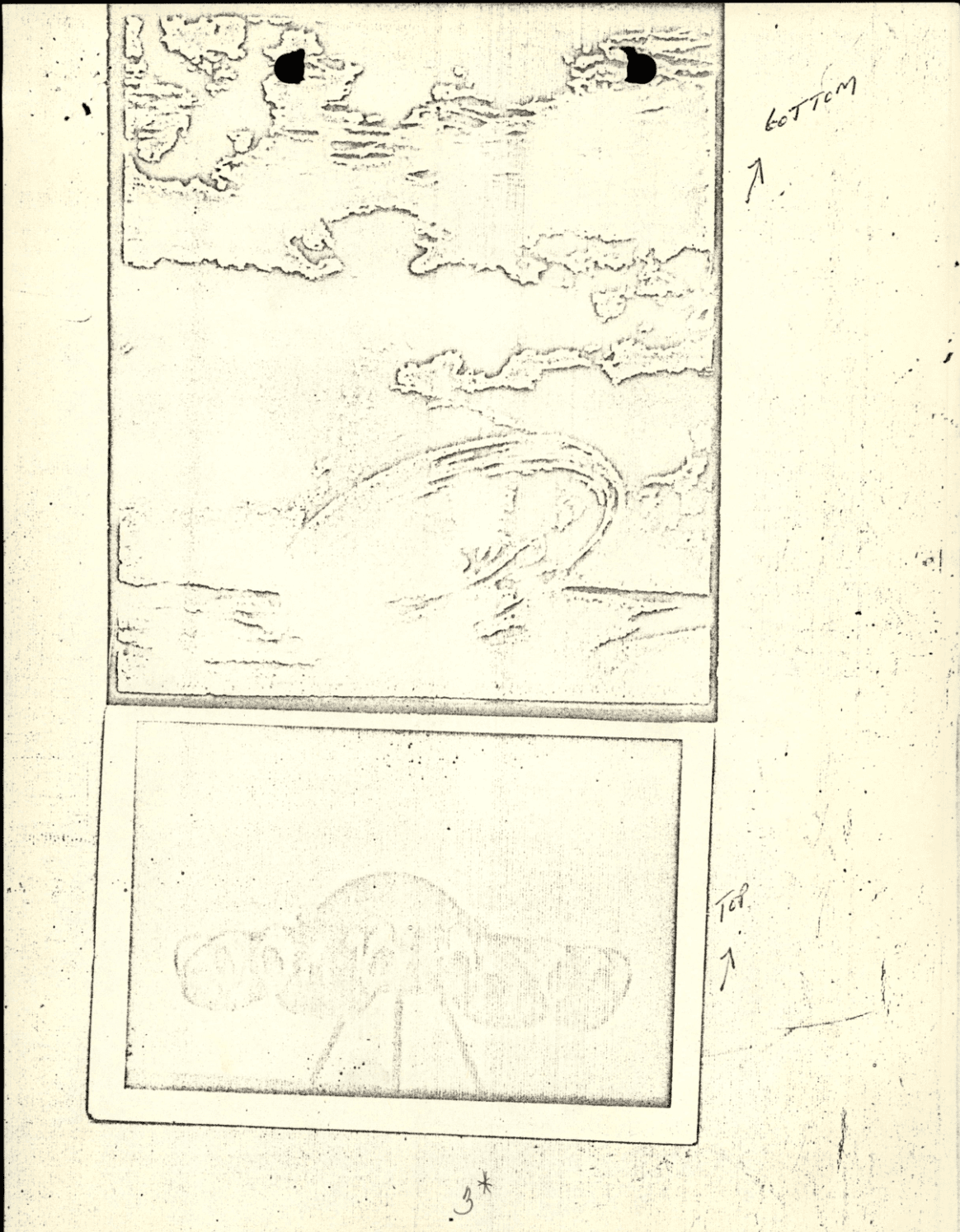
Peyerl claimed that during this assignment he had photographed a 21-foot saucer-shaped craft, radio-controlled, with jet engines arranged around its rim and a fixed central dome. He produced Xerox copies of the photographs. One showed the craft in flight at approximately 7,000 meters altitude. The other showed it parked in a hangar.
The photographs were taken in. They went into the file. The standard form-letter response to Peyerl's claim followed: not within our jurisdiction; please contact the Air Force.
Peyerl was not the only postwar German or Austrian to write the U.S. government claiming to have invented or worked on disc-shaped aircraft. The archives contain at least three other examples , including Adolf Dornig in 1954 and an anonymous letter to the Cincinnati Enquirer claiming the saucers were 1944-design Wehrmacht V-weapons in Russian hands. Whether any of these claims were true, fabricated, or psychological warfare seeded by Soviet intelligence has never been resolved.
9. CAP Wisconsin: Six Thousand Miles Per Hour
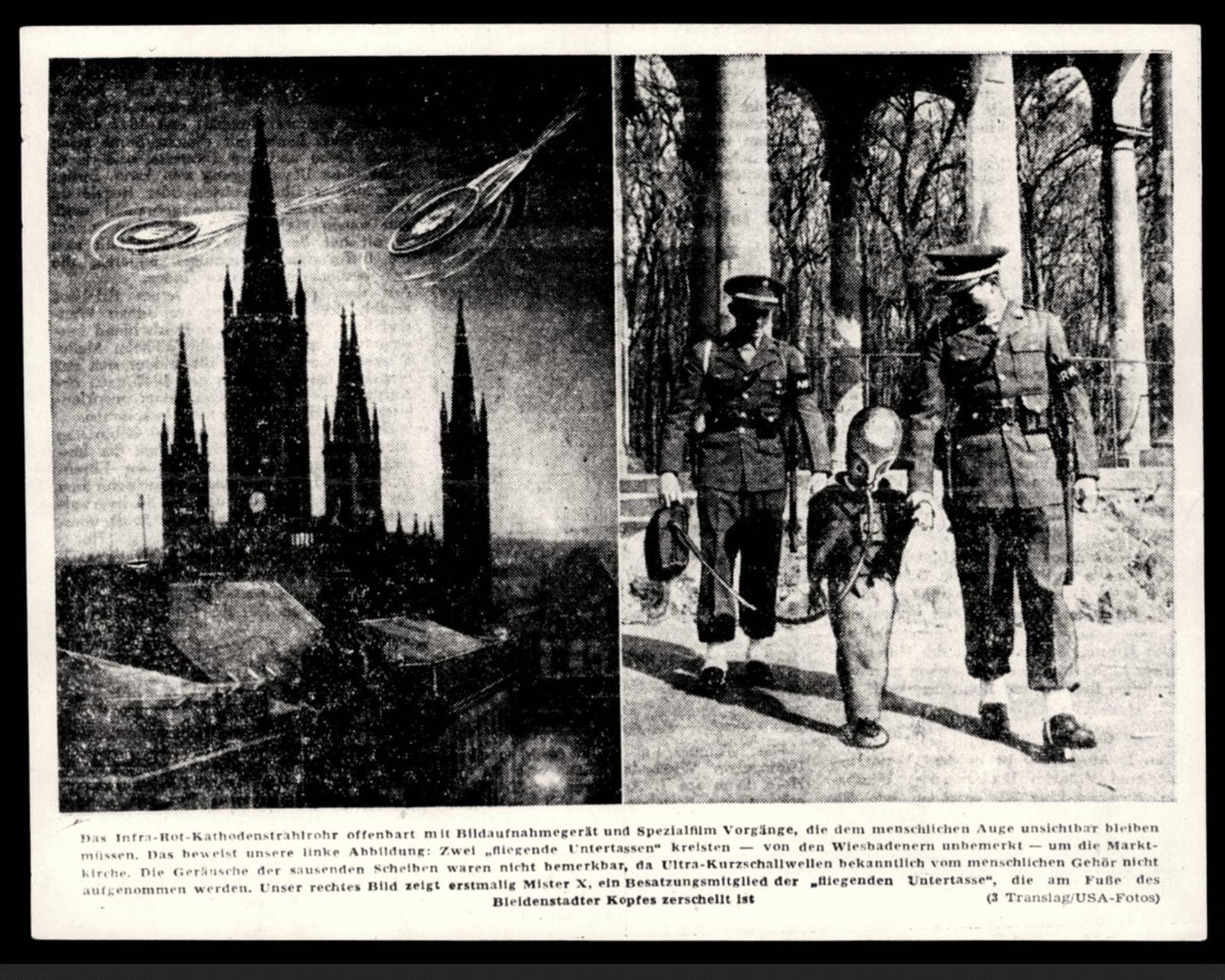
On July 7, 1947, two airplanes flown by Civil Air Patrol instructors and pilots were in the air over southern Wisconsin. The first crew was over Koshkonong; the second over East Troy.
In two separate, independent observations less than three hours apart, both crews reported the same unidentified flying object.
The first observation: 6,000 miles per hour. Calculated by clocking the object covering 25 miles in 15 seconds while the airplane was at 800 feet above ground and the object at 4,000 MSL.
The second observation: 3,960 miles per hour. Twenty-two miles in twenty seconds.
But it's the maneuvers that are remarkable. The saucer descended vertically, edgewise, through altocumulus clouds. Stopped at 4,000 feet. Assumed a horizontal position. Proceeded in horizontal flight for 15 seconds, covering 25 miles. Stopped again. Disappeared. Then reappeared 10 miles farther along its course six seconds later before its final disappearance.
The official report was written by Major John D. Schindler Jr., AAF-CAP Liaison Officer, on Civil Air Patrol Wisconsin Wing Headquarters letterhead.
In 1947, the fastest aircraft in U.S. inventory was the Lockheed P-80, with a top speed of about 600 mph. The saucer reported by the CAP pilots was traveling at speeds ten times faster than the fastest American jet, and stopping vertically in mid-air to do it.
10. The Shaved Monkey
July 1953. Atlanta, Georgia. Three men walked into the offices of the Atlanta Constitution and told a story.
A barber named Edward Walters. A butcher named Arnold Payne. Another barber named Thomas Wilson.
After one beer apiece — they emphasized this — they had been driving on Bankhead Highway near Mableton when they saw a flying saucer descend toward the road. They stopped the car. The saucer rose and disappeared. In the road in front of them, they said, was a 21-inch hairless humanoid corpse.
They put the body in their trunk. Took it to a freezer. Packed it in dry ice.
The Atlanta Constitution photographed Walters posing with the corpse. The photo ran in the Washington Daily Newsthe next day. National wire services picked it up.
For about 36 hours, Walters, Payne, and Wilson held the front-page story of the United States. Then Dr. W.A. Mickle, a professor of anatomy at Emory University, examined the body. His finding: a shaved Rhesus monkey, with its tail amputated.
The men confessed. No federal jurisdiction applied, the matter was a state issue and a public relations one. But the file was kept because of what it represented: the first widely-reported “alien corpse” hoax in American history, and one of the templates for everything that followed.
11. The Inventor of the Flying Saucer
On January 30, 1954, a woman named Olga Pivec walked into the federal office in Newark, New Jersey, against her husband's wishes, carrying two letters. Her husband, Alois Pivec, lived in East Orange. The letters were from his correspondent, a man in Klagenfurt-West, Austria named Adolf Dornig.
Translated from German, Dornig's claims were:
He had discovered an aerodynamic law unknown to science before World War II. His associates had emigrated to South America with the design and built saucers there with 2,600 to 2,800 km range. About 60 percent of the test flights had been fatal. The American flying saucer phenomenon, Dornig wrote, was his invention being flown over the United States by his old comrades from South America.
Russian agents had been hunting him to extract the design. He had been beaten in 1953 by a Communist who had tried to lure him to Switzerland. He had already written President Truman, President Eisenhower, the Pentagon, Scotland Yard, and the Royal Canadian Air Force. All had rejected him.
The letters were taken in.
The case was filed under serial 62-83894-339, then renumbered to 62-101030 on May 5, 1954, meaning the Dornig material was moved into a separate, dedicated case file. That alone signals it was taken seriously enough to track in isolation.
What was actually in the Klagenfurt apartment of Adolf Dornig — engineering drawings, fantasy, paranoia, or something genuine — has never been determined. The separate Dornig file has never been declassified.
12. The 4 A.M. Abduction Walk-In
In January 1967, the federal office in Chesapeake, Virginia was open at 4 in the morning. A man named James C. Collins walked in.
His report, as recorded by the duty agent:
A large oblong transparent craft had alighted in front of him. He had been taken aboard by a crew of approximately four. The crew members were about four feet tall. They were dressed in trouser pants and T-shirts. He had lost eight hours of time.
The agent wrote down what Collins said. The standard processing followed: not within our jurisdiction. Refer to the Air Force. The case was indexed under serial 457 and filed.
Collins's account is one of the earliest abduction-style reports in the federal archives, predating the Pascagoula abduction by six years and the famous Travis Walton case by eight. It contains every element of the later abduction template: short crew, lost time, vehicle “alighting,” the witness coming forward in a state of distress.
But the case was treated the way every UFO walk-in was treated during the Hoover era: write it down, refer it out, take no further action. A police-station logbook entry. No investigation. No psychological evaluation. No follow-up interview.
Just a man in Chesapeake, Virginia, walking through a door at four in the morning.
What These Twelve Documents Have in Common
Across thirty years of declassified UFO records, the federal posture almost never changed. Investigators wrote down what witnesses said. They documented physical evidence when it was found. They catalogued the hoaxes when they were exposed. They filed the photographs that were handed over. And they referred the entire problem — whether the witness was a small-town cop, a Pan Am captain, an NRL scientist, or a 4 a.m. walk-in — to the Air Force.
The Air Force, in turn, ran Project Sign, then Grudge, then Blue Book, and finally closed the public-facing investigation in 1969 after concluding the phenomenon posed no national security threat. When Carter's White House asked in 1977 how UFO reports were being handled, the answer was the same it had been for thirty years: not our jurisdiction.
The documents in these files were never meant to prove anything. No conclusions, no recommendations, no theories. They simply wrote down what was reported and what was found. That restraint is what makes them readable as historical records eighty years later , not as evidence of any single answer, but as evidence of the questions a government found itself unable to either solve or ignore.