Prediction markets are a tool, to help you stay informed, but without the bias everyday media employs. The more people who think it will happen, the higher the probability. That's true in many things, yet with prediction markets there is real money on the line.
Here are some examples:
The Florida Governor Republican Primary
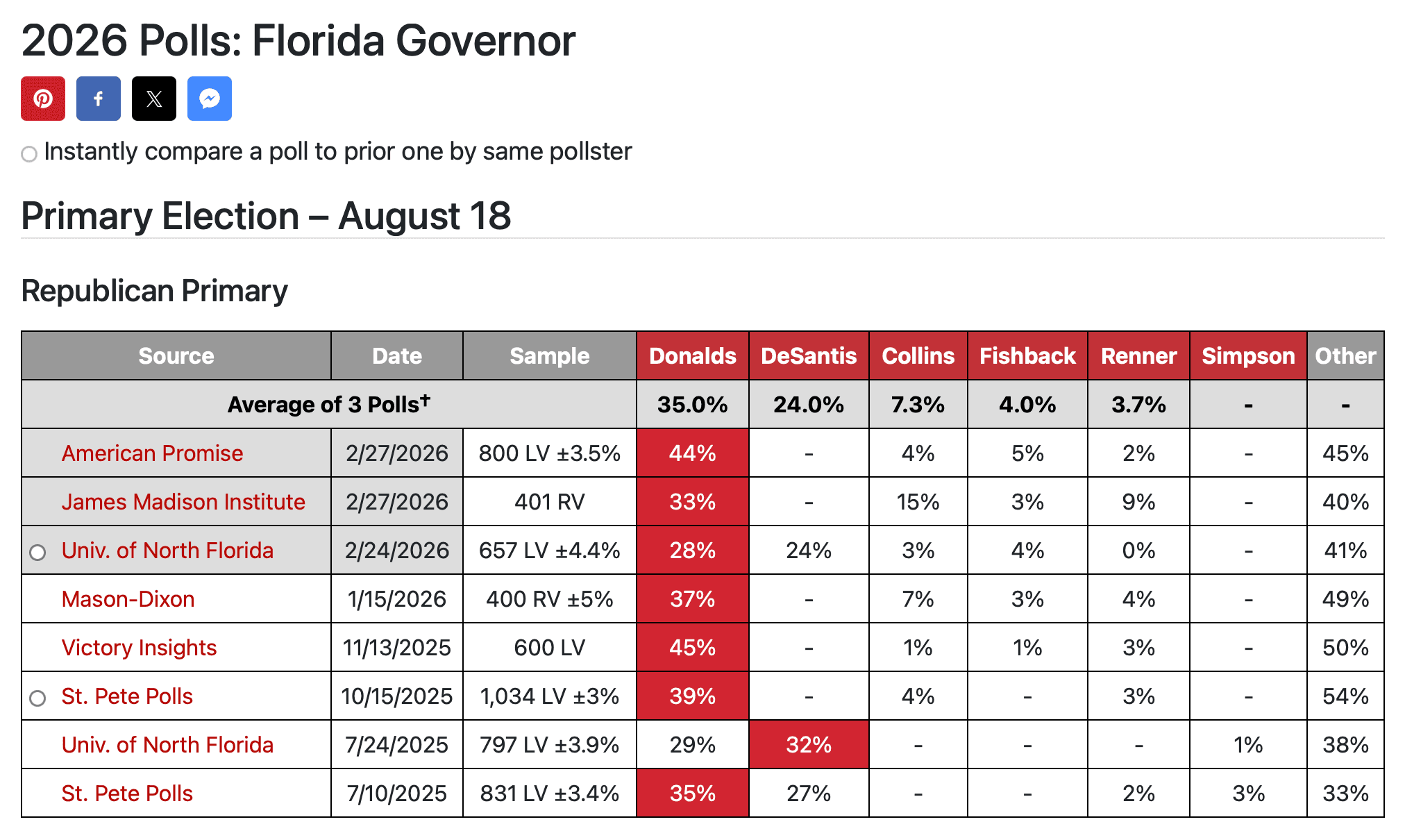
Polls from numerous sources, none showing Byron Donalds with higher than a 50% chance of winning the primary.
A quote from James Fishback regarding his chances of winning in November:
“We're going to win this thing and it's not even gonna be close.” at a February 2026 rally
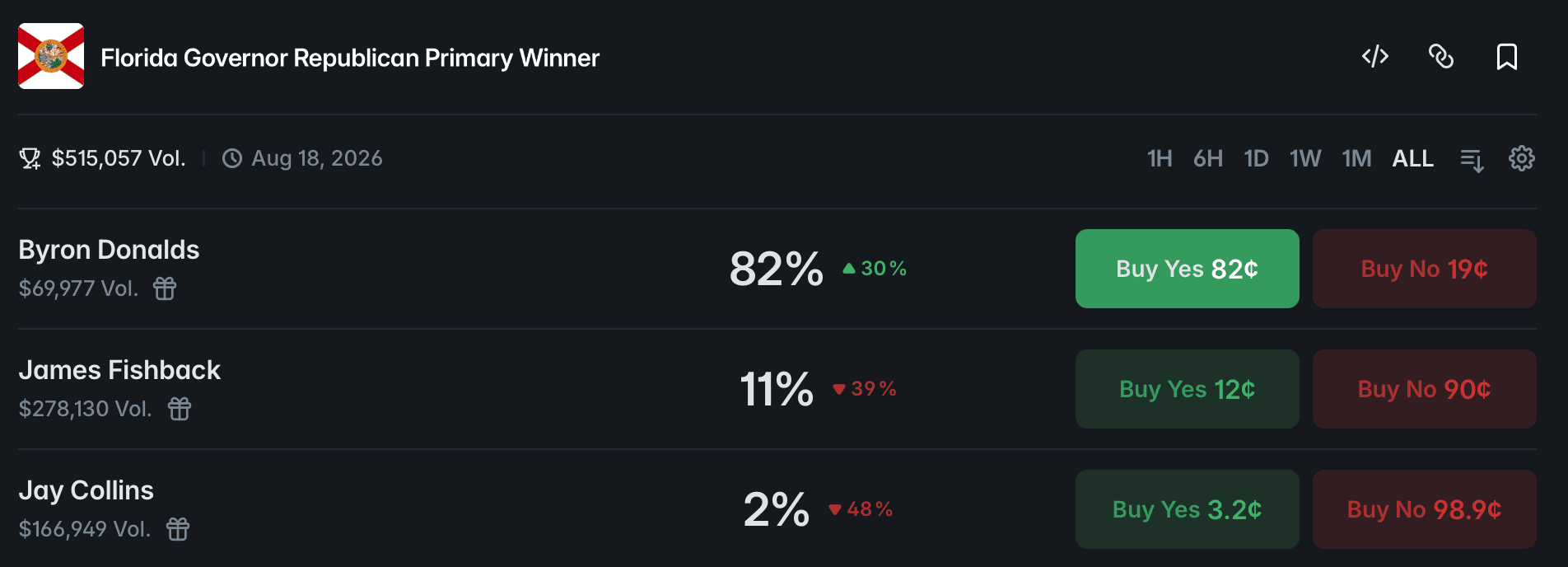
And here are the Polymarket odds:
If you're new to prediction markets, let's start with the basics:
The event is: “Florida Governor Republican Primary Winner” The choices (some call them markets) are Byron, James, Casey, followed by a few others. If you think Byron Donalds is going to win, you can go on Polymarket and place a bet for $0.82 on the dollar and get $1 back if he wins. For James Fishback, you'd be paying around $0.11–0.12 cents on the dollar and get a dollar back if he wins. If you place a bet and you lose, you get nothing back.
So, Byron Donalds has an 82% chance of winning the primary, followed by James Fishback with an 11% chance and Casey DeSantis (not shown) with a 1% chance. If you followed the polls or even James Fishback himself, you might think his odds or some of the other candidates odds are a lot higher, yet in reality that's not true.
The Netflix/Warner Bros Merger
Netflix CEO Ted Sarandos in December 2025 speaking about the chances of Netflix ultimately acquiring Warner Bros:
“We have a deal done. We're super confident we're going to get it across the line and finish”
And here is Deadline, a highly popular source providing news on the entertainment industry:
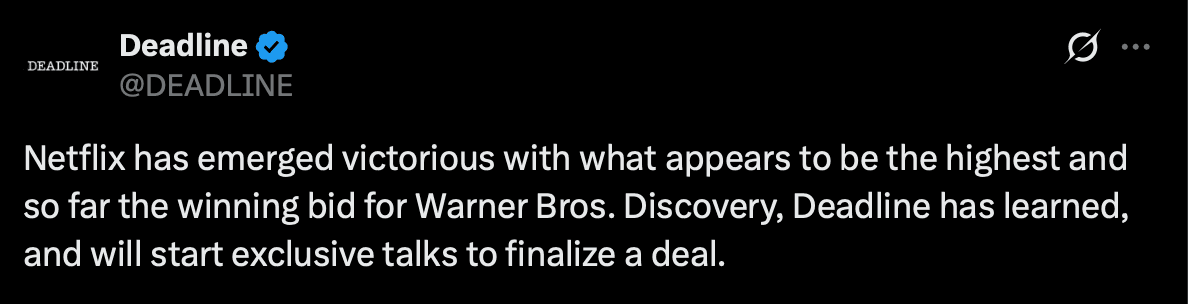
This was followed by literally thousands of accounts speculating on what they were going to do with their Netflix shares, or how the finalized HBO/Netflix integration would look. Yet,
Polymarket was telling a different story:
As the deal started to “finalize”, the odds for Paramount skyrocketed:
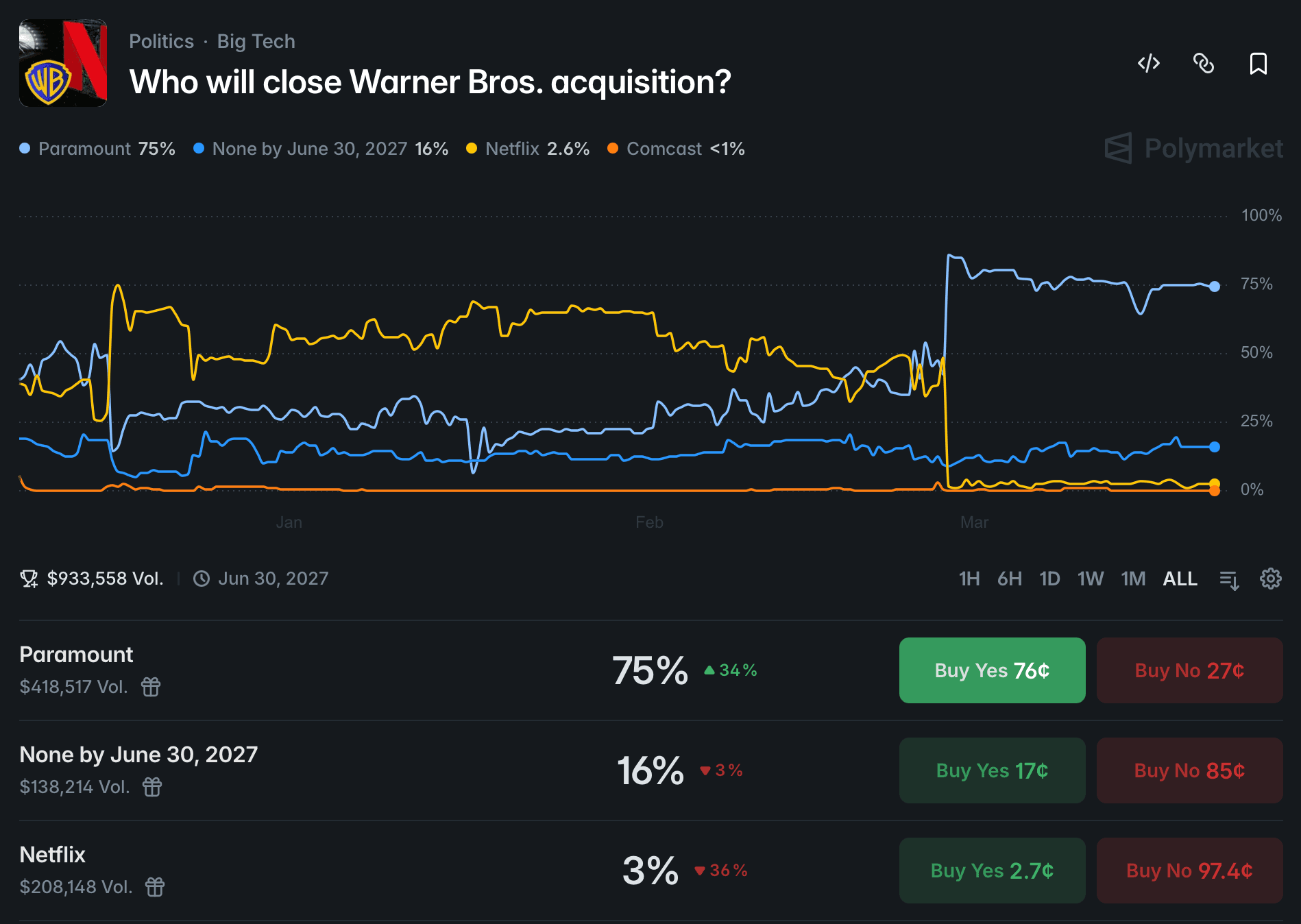
One could be forgiven for thinking the Netflix deal would finalize—they won the bid and they were the favorite to finalize the deal. Yet, they are still subject to a regulatory review process under the FTC, which ultimately given the political climate, favors Paramount.
If you had followed Polymarket, you would have known the deal to acquire Warner Bros by Netflix was never 100%, and it never even crossed 70%. The odds for Paramount, however, were gaining steam and are now ultimately the favorite by a long shot.
These are just two of the many examples of Polymarket having a massive edge over what we see and hear on the news and social media.
The Accuracy
Across 90,000 resolved Polymarket predictions, the platform achieved a Brier score of 0.058 twelve hours before resolution (McCullough, Dune Analytics). For context, a Brier score below 0.125 is considered good and below 0.1 is great. Polymarket sits comfortably in “great” territory (Tabarrok, Marginal Revolution). Markets with over $1 million in trading volume, or high-liquidity markets performed even better, hitting 0.026 at twelve hours out and 0.016 one day prior (McCullough, Dune Analytics). Compare that to sports betting lines, which average 0.18–0.22, or state-of-the-art weather forecasting for rain, which ranges between 0.05–0.12 (Tabarrok, Marginal Revolution). When a prediction market tells you to bring an umbrella, you bring an umbrella.
The Platforms
Polymarket
Polymarket is the most famous prediction market platform and has the highest volume. They were also the first, or are they? The CFTC has forever been the bane of successful and mainstream prediction markets. The Iowa electronic markets which got started in the late 80's and Intrade (platform from Ireland) were both shut down by the CFTC due to “unlicensed options trading.”
Polymarket solved this problem by building on the blockchain. Now, users around the world can access Polymarket with no monetary restrictions, leading to massive liquidity, which is ultimately what these markets needed. With smart contracts, this allowed 24/7 trading and instant settlement. More importantly, these contracts took out the middleman. The smart contracts hold the funds and therefore reduce the potential of fraud.
Kalshi
Kalshi, the 2nd most popular prediction platform, took an alternative route to success. They went through the CFTC. Seemingly, Polymarket's popularity by building on the blockchain, most likely led to the formation of Kalshi, given that prediction markets were already very popular and there shouldn't just be one platform leading the charge.
The Differences
Polymarket, being built on the blockchain takes most of the cryptocurrency volume. Bitcoin, Ethereum and Solana markets all trade with extremely high liquidity compared to Kalshi, but the gap has tightened. In the last year alone, Kalshi has gone neck and neck with Polymarket and established themselves as not just #2 but close to a clear tie with #1. Kalshi is also easier to use if you live in the U.S., given that they have been approved by regulators. There are however, limitations. Given that Kalshi relies on the CFTC for market approval, there are limits to what they can create. Polymarket can create a market for just about anything.
Conclusion
The next time you see a headline, check what the market says. You might get a very different story.