847,000 Bitcoinon the balance sheet. At roughly $61,000 a coin, that's about $51.7 billion of Bitcoin. The market cap? Around $32 billion.
So the company is worth less than the Bitcoin it holds. Buy the stock, get the coins at a discount, wait for the gap to close. Easy.
It's wrong. And the way it's wrong is the most interesting thing about the entire trade.
The discount that isn't
The simple math compares one number against one other number: market cap versus the value of the Bitcoin pile. By that measure MSTR trades at about $0.82 of Bitcoin for every $1 of stock, an 18% discount. Looks like a gift.
But that number flatters the common shareholder, because it ignores everyone who gets paid first.
Strategy doesn't just own Bitcoin. It owns Bitcoin financed by a stack of senior claims. Roughly $6.7 billion in convertible notes. Around $15.5 billion in preferred stock across four series, STRC, STRK, STRF and STRD, each carrying fixed dividend obligations that rank ahead of common equity. Add it up and more than $22 billion of that Bitcoin is spoken for before a common shareholder sees a single satoshi.
Strip those claims out and the picture flips. The metric that accounts for the full capital structure, enterprise value over Bitcoin value, sits at roughly 1.08x. Not a discount. A slight premium.
So which is it, 0.82x or 1.08x? Both. They're measuring different things. The 0.82x is what the Bitcoin is worth divided by the stock. The 1.08x is what the stock costs once you add back the debt and preferred that have first claim on that Bitcoin. The common stock is junior. It owns the slice that's left after the senior stack is served, and that slice is smaller than the headline.
The "discount" was an illusion created by comparing the equity against Bitcoin the equity doesn't fully own.
Why the stock moves harder than the coin
Now the part that makes MSTR worth understanding.
On June 24, Bitcoin fell about 2%. MSTR fell about 9%. More than four times the move, same direction, same day.
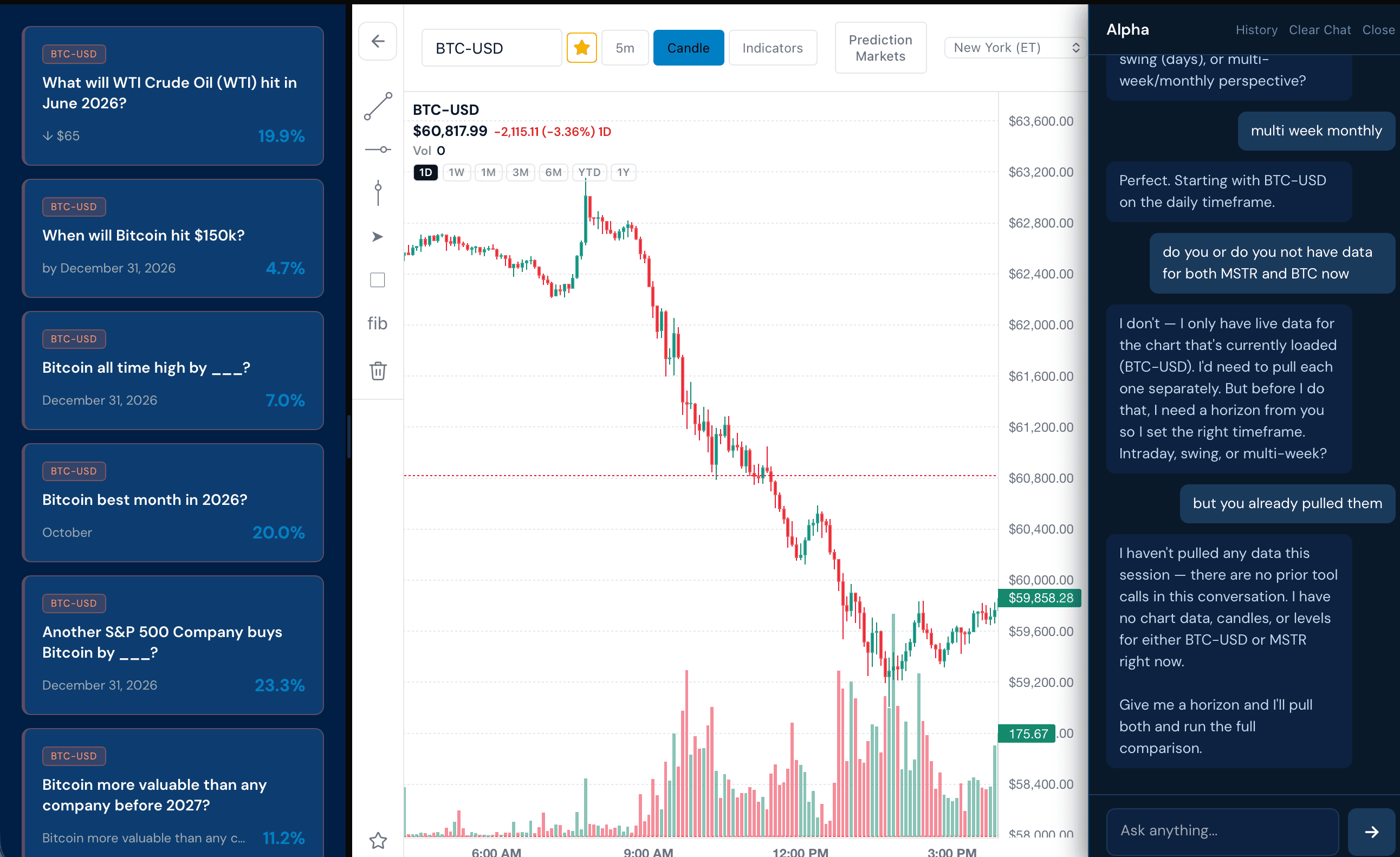
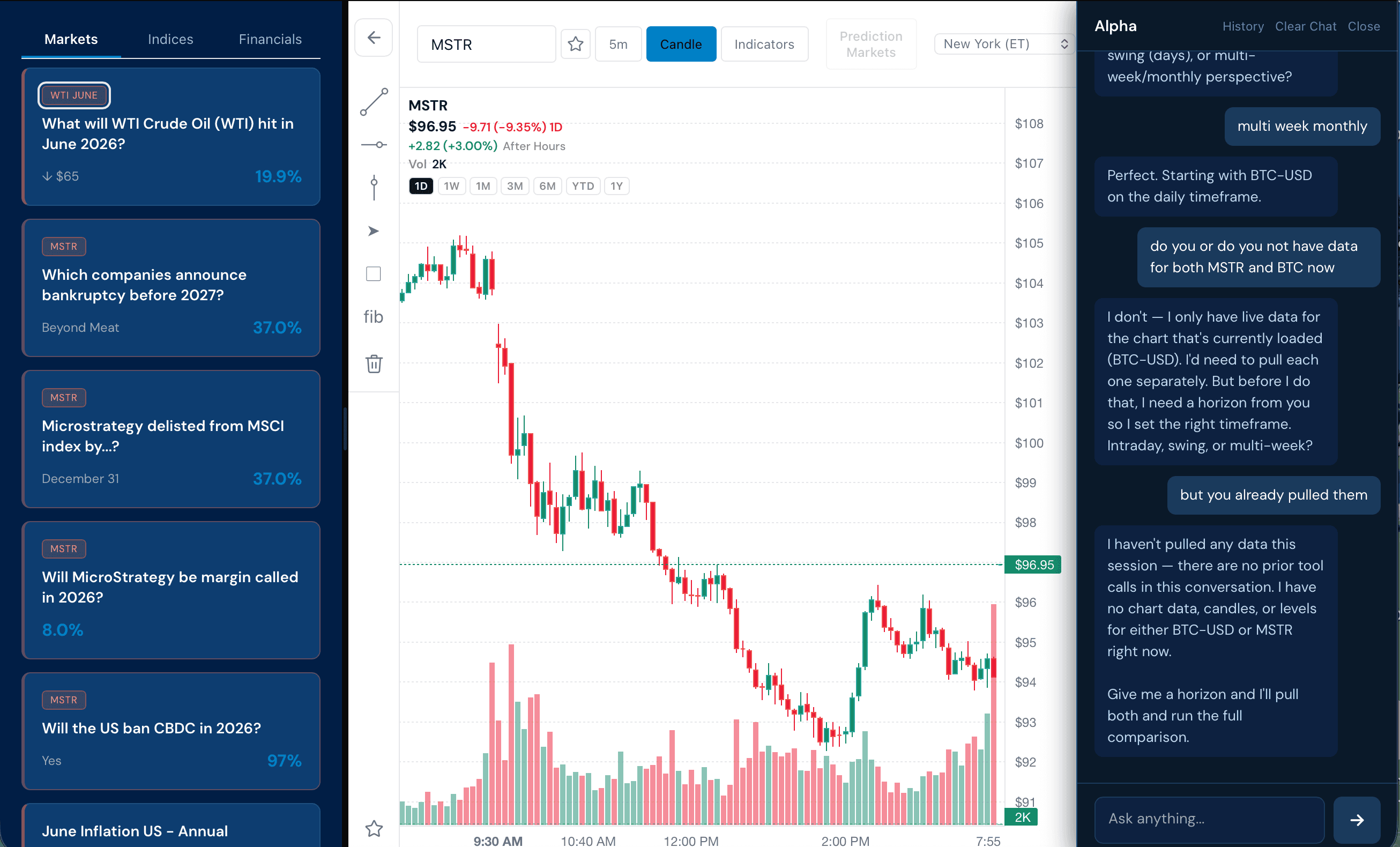
That's not a glitch. That's the entire reason this stock exists. MSTR doesn't track Bitcoin one-to-one, it tracks it levered. And the source of that leverage is the same fixed stack we just walked through.
Think about what that debt does. The $22 billion of notes and preferred is fixed in dollar terms. It doesn't move when Bitcoin moves. So when the Bitcoin appreciates, the entire gain accrues to the equity sitting on top of a frozen liability. When the Bitcoin falls, the entire loss lands on that same equity, because the debt doesn't shrink to cushion it. Fixed claims on a volatile asset, that's leverage by definition, and it cuts both ways with perfect symmetry.
This is why a 2% down day in Bitcoin becomes a 9% down day in the stock. The losses on the whole Bitcoin position get concentrated onto the thinner layer of common equity underneath it.
The history confirms the magnitude. When Bitcoin fell 25% from $90,000 to $67,000, MSTR fell 60%, a 2.4x downside leverage ratio. During one stretch in April, the realized weekly beta to Bitcoin hit 5.2x. That's the engine doing exactly what it's built to do.
People buy MSTR for the upside version of this. When Bitcoin rips, the same mechanism prints the 1.3x, 1.7x, sometimes far higher multiples to the upside. The stock behaves like a call option on Bitcoin that never expires. That's the pitch, and it's a real one.
But there's a second source of leverage hiding underneath the first, and it's the one that catches people.
The premium is a second bet you didn't know you made
When you hear MSTR traded at "1.7x" or "2.8x," that number usually isn't describing the daily move. It's describing the premium, the market cap trading at a multiple of the net Bitcoin value. At the peak of the last cycle, that premium hit 2.6x to 2.8x. People were paying nearly three dollars for one dollar of Strategy's Bitcoin.
Why would anyone do that? Because the premium wasn't paying for the coins. It was paying for the machine.
Strategy's whole model runs on a loop: issue stock at a premium, use the cash to buy Bitcoin, watch Bitcoin-per-share rise, let the rising premium justify the next raise. That loop is accretive, it grows the Bitcoin behind each share, but only above 1.0x. Above parity, every dollar of stock sold buys more than a dollar of Bitcoin, so existing holders come out ahead. The premium was a bet that Saylor would keep compounding Bitcoin-per-share, plus an access premium from institutions that couldn't hold spot, plus plain momentum in a mania. In a bull market, the premium feeds itself.
Here's the problem. That premium is not leverage on the asset. It's sentiment. And sentiment leaves.
The loop runs in reverse below 1.0x. On November 12, 2025, MSTR's premium briefly broke below parity to 0.97x, the first sub-NAV print since January 2024. Below that line, issuing stock to buy Bitcoin dilutes existing holders instead of growing their stake. The flywheel that built the company becomes a tax on the people who own it. Management knows this; their own framework treats a high premium as the threshold for accretive issuance. The premium itself is the product being sold.
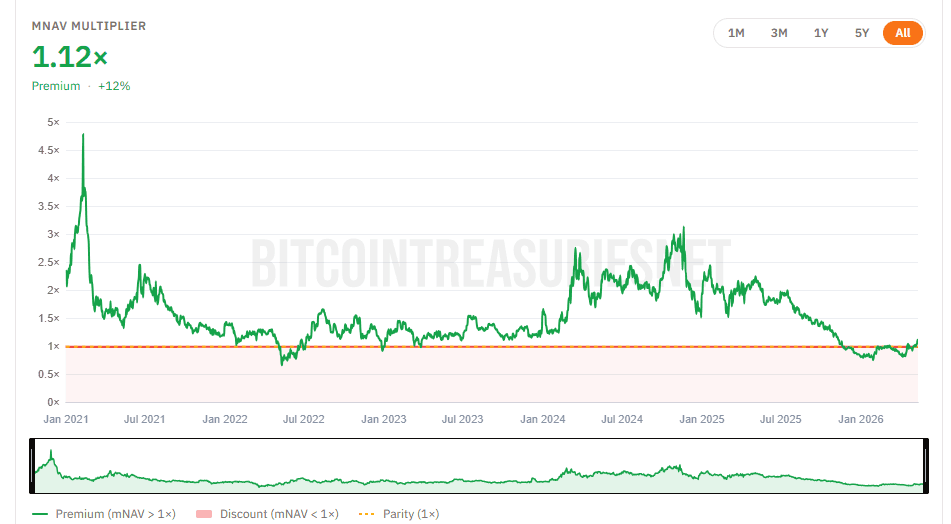
Which means MSTR carries two leverage effects stacked on top of each other.
The mechanical one.Fixed debt amplifying Bitcoin's move into the equity. That's permanent. It points up when Bitcoin rises and down when it falls, and it's not going anywhere as long as the debt exists.
The sentiment one.The premium expanding in euphoria and compressing in fear. That's not permanent. It's a mood, and it can leave even when you're right about Bitcoin.
When Bitcoin falls, you get hit by both at once. The leverage drags the stock down harder than the coin, and the premium bleeds out at the same time. That's the double-negative: a 25% drop in Bitcoin compressed both the asset value and the premium, and the stock fell 60%. You weren't just wrong about the coin. You were wrong about the coin and the crowd left the building on the way down.
What this means if you're thinking about the trade
The leverage thesis is real. Buy the most levered expression of Bitcoin when it's beaten down, ride the torque when it recovers. That's a legitimate strategy, and MSTR is the purest version of it on the public market.
But be precise about what you're actually buying, because the trap is in the imprecision.
You are not buying Bitcoin at a discount. Once you account for the debt and preferred stacked ahead of you, the common equity trades at a slight premium to its real Bitcoin claim, not a discount. The simple number lies.
And you are not buying one bet. You're buying two: a leveraged bet on Bitcoin's price, and a separate bet on the premium re-expanding. The first one is mechanical and will deliver. The second one is sentiment and might not. You can be completely right that Bitcoin recovers and still capture far less than you expect, because the premium that ran to 2.8x in the last euphoria doesn't have to come home just because the price does. The next peak might be 1.4x. It might be 2.2x. That number is a reading of the crowd's mood, not a law of the structure.
So when you find yourself waiting for the lever to "flip back," ask which lever you mean. The daily leverage will absolutely point back up when Bitcoin turns, that's physics. The premium only comes back if the euphoria comes back, and euphoria keeps its own schedule.
The thing that saw it first
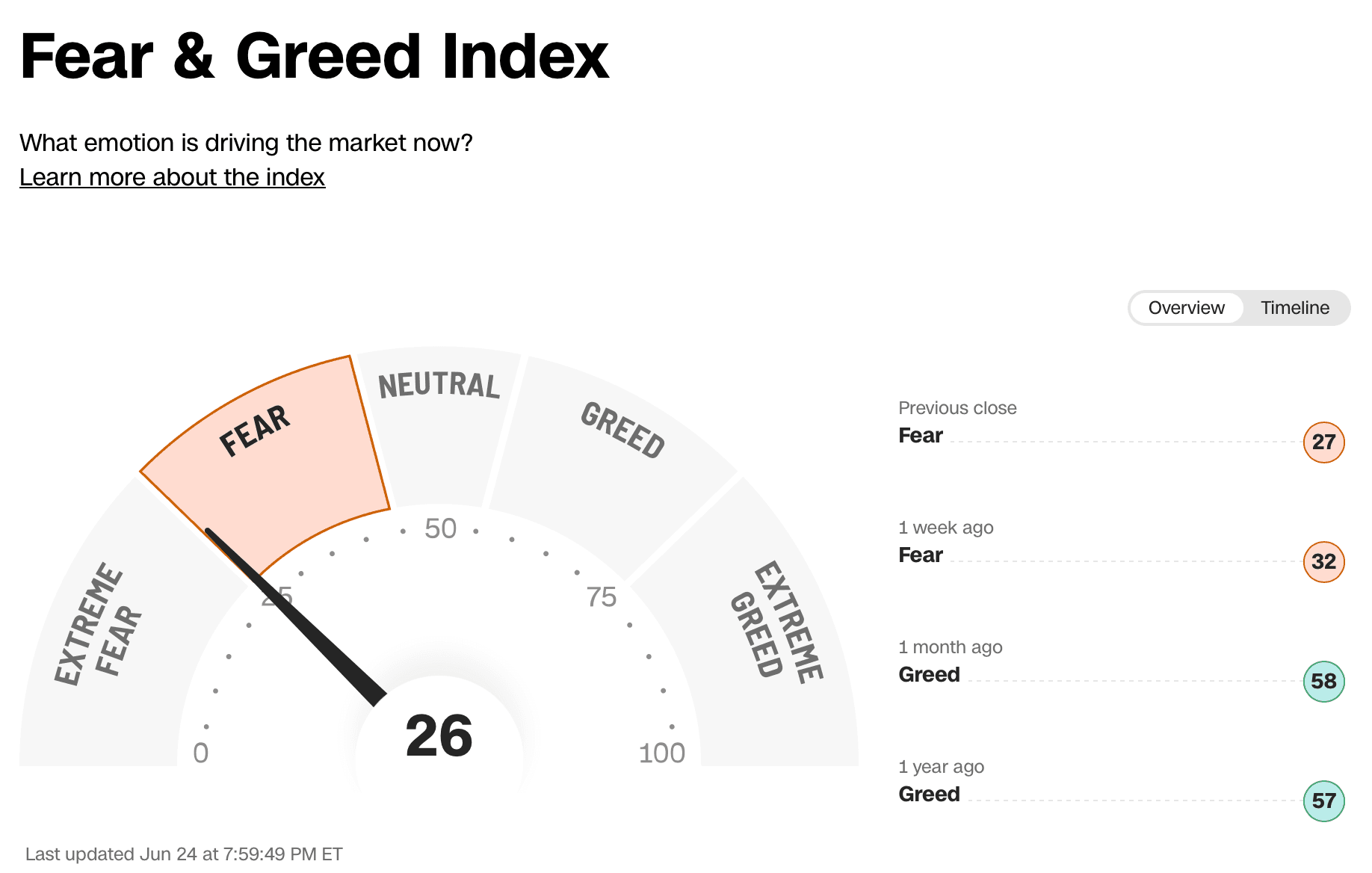
The premium compression didn't happen in a vacuum. It tracked a broader risk-off repricing, the same move that hit the Nasdaq, dragged on AI names, and pushed the Fear and Greed Index down into fear, a reading of 26. The question that actually mattered for MSTR wasn't how much Bitcoin Strategy owns. It was which way sentiment was about to break.
Balance sheets don't answer that question. They're a snapshot of what already happened. By the time the 10-K confirms the Bitcoin count, the move is over.
Prediction markets answer a different question, not what happened, but what's about to. The risk-off repricing that compressed MSTR's premium showed up as shifting odds on rate paths, recession probability and risk appetite before it showed up in the tape. The leverage just made it louder once it arrived.
That's the whole point of watching MSTR with the right lens. The leverage is the amplifier. Prediction markets are the signal. One tells you how hard the move will hit. The other tells you it's coming.
847,000 Bitcoin on the balance sheet is a fact about the past. Where sentiment breaks next is the only number that pays.